


How Does Phage Therapy Work?
Written by Dr. Alain Dublanchet, physician and honorary hospital biologist. — Updated on August 29, 2026.
Phage therapy uses natural viruses, bacteriophages, to destroy the bacteria that cause an infection. Each phage attacks only one bacterial species: the treatment is tailor-made from the bacterium sampled from the patient. Practised without interruption since 1923 at the Eliava Institute in Tbilisi, Georgia, it is today one of the few options against antibiotic-resistant infections.
The essentials in five points
- Principle — viruses that infect only bacteria, without affecting human, animal or plant cells.
- Timeline — 7 to 10 days to identify the active phage with a phagogram, then from a few weeks to 3 months of treatment.
- Specificity — a phage destroys only one species of bacteria: your gut and skin microbiota are preserved.
- Tolerance — a century of clinical use, with rare and mild reported side effects.
- Where — in Georgia, the only country where the practice has never stopped; the Eliava Institute keeps more than 6,000 strains there.
What is phage therapy?
Phages infect and destroy bacteria without harming human or animal cells. That is why this therapy is very well tolerated: over a century of clinical use, reported side effects have remained rare and mild.
The principle is to identify the virus suited to the infection, then apply it to the infected site so that it destroys the bacteria — and only them. These viruses then multiply on site and go on destroying the identical bacteria they encounter.
Phage therapy successfully treats antibiotic-resistant infections, starting with Staphylococcus aureus, but also Pseudomonas aeruginosa, Escherichia coli and Klebsiella. The conditions concerned are described in detail on a dedicated page.
Before considering it, consult a specialist doctor and turn to a team experienced in the use of phages.
What are bacteriophages?
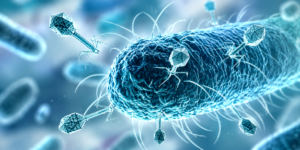
A phage binds to receptors on the surface of a bacterium, pierces its wall and enters the cell. Inside, it multiplies and destroys the bacterium by literally bursting it, in less than an hour. The new phages spread, meet neighbouring bacteria of the same species and repeat the process. Elimination becomes exponential.
Each phage is specific to a single bacterial species. This is what sets it radically apart from an antibiotic: the infection is eliminated without destroying the useful bacteria of the gut, mucous membranes and skin.
Phages are found everywhere — in water, soil and living beings — where they naturally regulate bacterial populations. Discovered in 1917, they have been studied for more than a hundred years and treated millions of patients before antibiotics arrived.
Phages or antibiotics: what are the differences?
Three practical consequences: the gut microbiota is preserved instead of being destroyed, side effects remain rare and transient, and resistance never leads to a dead end, since a more active phage can be selected.
Methodology, side effects, resistance mechanisms, bacterial targeting and production conditions: the subject is covered point by point on the page Phages and antibiotics compared.
What are the advantages and disadvantages of phage therapy?
The bacterium must first be sampled and cultured, and a phagogram — the search for the most active phage — carried out. This process takes 7 to 10 days. Treating a urinary tract infection can then take 2 to 3 months, and longer for multi-resistant osteitis.
On the other hand, unlike antibiotics, bacteriophages do not cause serious or lasting side effects.
Another decisive advantage: if a bacterium becomes resistant to the phages administered, a more active phage can be selected or adapted from the patient’s own strain. So there is never an absolute therapeutic dead end.
Is your infection resistant to antibiotics?
Describe your situation and the treatments you have already tried. A specialist doctor reviews your file and tells you whether phage therapy can help you. Reply within 5 working days, free of charge and with no obligation.
Get a free medical opinionHow are phages prepared?
A non-sterile sample is taken — river water, wastewater — which always contains many bacteria and their associated phages. The sample is homogenised and cleared of solid particles and bacteria. A drop is brought into contact with the bacterium to be fought, grown for 18 to 24 hours in a broth that has turned cloudy.
After a few hours of incubation, the broth clears: this shows that the specific phage has recognised “its” bacterium and destroyed it. This is lysis. The operation is repeated from the cleared medium. Adding chloroform eliminates the remaining bacteria without damaging the phages; centrifugation and fine filtration remove the remaining particles.
In this way, a laboratory obtains within a few days the phages active against a bacterium isolated from a patient. Industrial production of therapeutic phages is far more demanding: purity, concentration and activity tests are strictly supervised by health authorities, as for any medicine.
Artificial intelligence is starting to be used to shorten this timeframe, by selecting suitable phages from banks of already characterised strains. The approach is promising but still under study.
How are phages administered?
Depending on the location, phages are applied locally, injected, nebulised or infiltrated: mesotherapy for folliculitis, inhalations for lung involvement as in cystic fibrosis. The liquid form remains the most common, but there are also tablets, ointments and phages incorporated into orthopaedic bone cement.
As phages are sensitive to acidity, oral treatment is preceded by a dose of baking soda (sodium bicarbonate) to neutralise stomach acid.
The full process is described on the page Phage therapy treatment protocol.
Who discovered phage therapy?
Phage therapy was invented in 1919 by Félix d’Hérelle, a French-Canadian researcher at the Institut Pasteur, two years after he discovered bacteriophages.
In 1917, he noticed that samples from patients with dysentery, placed on a Petri dish, produced “clear spots” where the bacteria had disappeared. By transferring these spots to other cultures, he obtained the same effect and concluded that a bacteria-killing microbe was present. He named it bacteriophage, from the Greek phagein, to eat: a bacteria eater.
The hypothesis was bold. The electron microscope would not appear until the 1940s, so these organisms could not be observed at the time. D’Hérelle faced fierce criticism, notably from Nobel laureate Jules Bordet.
In 1919, he isolated these active bacteriophages and gave them to animals, then to patients. To convince his colleagues that they were harmless, he swallowed his own preparations. He then treated children suffering from shigellosis — common and often fatal at the time — and cured them. Phage therapy was born, and it spread quickly across Europe, the Americas and Asia.
Why are phages not used in France?
After the Second World War, antibiotics — easier to study, produce and prescribe — took over. Production and sale of phages gradually stopped in France and the West. Antibiotic resistance was not an issue at the time; phages fell into disuse, largely unnoticed.
Today, the rapid growth of antibiotic resistance is bringing this solution back to the fore. One obstacle remains: phages were not invented but taken from nature. They therefore cannot be patented, which has long discouraged the pharmaceutical industry. The regulatory framework remains complex.
Experts and scientific resources
- Dr. Alain Dublanchet — French phage therapy expert who has been working for more than twenty years for its return to Europe.
- Laurent Debarbieux — researcher at the Institut Pasteur in Paris.
- American Society for Microbiology — overview of the past, present and future of phage therapy.
- French Parliamentary Office for the Evaluation of Scientific and Technological Choices (OPECST) — hearing of March 4, 2021.
Why is phage therapy authorised in Georgia?
The dedicated research institute was founded that year in Tbilisi by the Georgian bacteriologist Giorgi Eliava. He had met Félix d’Hérelle at the Institut Pasteur in Paris between 1919 and 1921 and invited him to work in his laboratory. D’Hérelle travelled to Tbilisi in 1933 and 1934, then worked there for about eighteen months from 1934, during which he wrote Le Bactériophage et le phénomène de la guérison (1935). The institute now bears its founder’s name: the Eliava Institute.
During the Soviet era, as antibiotics were less accessible than in the West, phages continued to be studied, produced and prescribed. This continuity has given Georgia more than a hundred years of uninterrupted practice and one of the largest phage collections in the world, estimated at more than 6,000 strains.
Phage therapy is still taught today in Georgian medical schools, which is not the case anywhere in the West. Georgian doctors therefore have know-how, clinical experience and authorisations that do not exist elsewhere. The remaining question is where to get treated.
On this site you will find everything you need to understand phage therapy and assess whether it suits your situation, starting with the testimonials of patients already treated. To go further, you can request a personalised medical opinion or check the cost of phage therapy in Georgia.
Find out whether phage therapy can help you
The questionnaire takes just a few minutes. Your file is passed on to the doctors of the Eliava Institute, who reply within 5 working days. It is free and you are under no obligation.
Request a medical opinion Read patient testimonials