


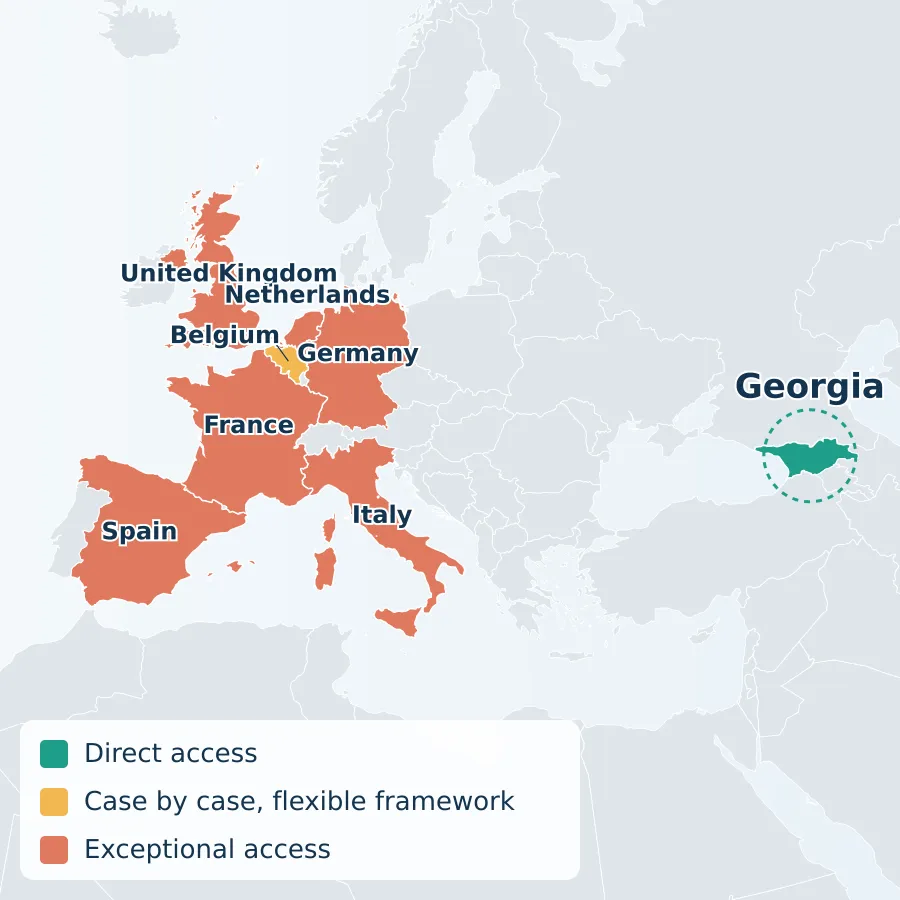
In Europe, phage therapy is not approved as a medicine in any country: access is granted case by case, and the vast majority of requests never lead to treatment. In Belgium, fewer than 1 request in 10 resulted in treatment; in France, about 1 in 6.
You may have heard about phages from your doctor, in a documentary or on a patient forum. And you are wondering: can I be treated in my own country? This page gives you the answer, backed by official figures, so that you know exactly what to expect before you start any process.
Three reasons explain why treatment is so rare in Europe:
- No phage product has a marketing authorisation. Every treatment is therefore an exception, granted patient by patient.
- Very few pharmaceutical-grade phages are available, and only against a handful of bacteria.
- Authorisations mainly target severe bone and prosthetic joint infections. Other infections rarely qualify.
The legal framework, country by country
| Country | Phages approved as a medicine? | How to access them | What it means for you |
|---|---|---|---|
| France | No | Compassionate access granted by the ANSM (French medicines agency), requested by a hospital doctor; clinical trials | A reference centre (mainly Lyon) must accept your case, then the ANSM must approve it |
| Belgium | No | Magistral preparations: a pharmacist prepares the phages on prescription, for one specific patient | The most flexible framework in Europe, but available phages remain limited |
| Germany | No — no phage product approved | “Individual treatment attempt” under the doctor’s responsibility; preparation by a pharmacy or hospital | You depend on a doctor willing to take responsibility; no dedicated official framework |
| Netherlands | No | Experimental treatment decided by a team of doctors, phages prepared by hospital pharmacists; first personalised treatment in February 2025 (UMC Utrecht) | The framework is only just starting; very few patients so far |
| Italy | No | Compassionate use: individual prescription and approval by an ethics committee; hospital-pharmacy preparation still being defined | Access is possible but exceptional; a first hospital preparation was made in Pisa |
| Spain | No | No specific framework; compassionate use for patients whose life is at risk; no magistral preparation to date | Exceptional access, reserved for the most serious cases |
| United Kingdom | No | Unlicensed medicines and clinical trials; guidance from the medicines regulator (MHRA) published in June 2025 | The framework is being built; access remains exceptional |
| Georgia | Phages are recognised by the Georgian health authority | Direct consultation at the Eliava Institute in Tbilisi | No authorisation to wait for: your case is reviewed by the Institute’s doctors |
How many requests actually succeed?
Europe’s two main centres publish their figures: most patients who ask for phages are never treated.
| Centre | Period | Requests received | Patients treated | Rate |
|---|---|---|---|---|
| Queen Astrid Military Hospital, Brussels (Belgium) | 2008 – April 2022 | 1,066 | 100 | 9.4% |
| PHAGEinLYON programme, Hospices Civils de Lyon (France) | 2017 – 2025 | 786 opinions issued | 135 | about 17% |
| ANSM compassionate access, anti-Staphylococcus aureus phages (France) | May 2022 – October 2023 | 28 patients deemed eligible | 13 | 46% of already-selected patients |
In Germany, specialists estimate that “probably hardly 100 patients” have been treated in recent years, for lack of a framework and of available phages.
For French compassionate access, the ANSM did not refuse a single case: the selection happens earlier. Cases were dropped because of a medical decision, removal of the prosthesis, inclusion in a clinical trial, inability to administer the treatment, or the patient’s refusal. And only a severe bone infection caused by Staphylococcus aureus qualifies for this framework.
Which infections are treated, and where?
In Europe, phages go first to bone infections and infected prostheses and, to a lesser extent, to severe lung infections. Urinary tract infections hardly appear anywhere in the published figures.
| Infection | France | Belgium | Germany | Georgia (Eliava Institute) |
|---|---|---|---|---|
| Bones, joints, prostheses | Yes — the only indication of the official compassionate framework (Staphylococcus aureus) | Yes — 14% of infections treated | Yes — implant and prosthesis infections | Yes |
| Lungs | Rare — a few cases (cystic fibrosis, ventilator-associated pneumonia) outside the official framework | Yes — first indication: 25% of infections treated | Yes — ventilator-associated pneumonia, empyema | Yes |
| Skin, chronic wounds | Not documented | Yes — 23% | Yes | Yes |
| Heart, bloodstream (endocarditis, bacteraemia) | Yes, case by case | Yes — 10 cases, as secondary infections | Yes (cardiac implants) | Reviewed case by case |
| Urinary tract | Absent from published data | 2 cases out of 114 infections, always as secondary infections | Not mentioned | Yes — a common indication |
In practice, if you suffer from a resistant or recurrent urinary tract infection, your chances of obtaining phages in France or Belgium are very low today. For a lung infection, access exists but remains exceptional in France.
In Georgia: what changes for you
If your request is refused in your country, or if your infection does not fit any authorised framework, Georgia remains an alternative. The Eliava Institute reviews all types of bacterial infections and holds, according to its own figures, one of the largest collections in the world: more than 1,000 active phages and more than 12,000 reference bacterial strains.
In Tbilisi, you do not need an exceptional authorisation: phages are recognised by the Georgian health authority, and the Eliava Institute treats patients from more than 80 countries.
- Your case is reviewed directly by the Institute’s doctors, without going through a reference centre or a medicines agency.
- All infection sites are reviewed, including urinary, intestinal and ENT infections, which are rarely treated in Europe.
You keep your own doctor in the loop: the Institute’s report is given to you so that your doctor can follow your treatment.
Would you like to know whether your infection can be treated? Request a personalised medical opinion.
This page is for information only. It does not replace your doctor’s advice. Figures come from the publications listed below, as of 16 October 2026.
Sources
- ANSM — Compassionate access, anti-Staphylococcus aureus bacteriophages, summary of report no. 5 (May 2022 – October 2023)
- Phage therapy: literature review and access to this re-emerging treatment in France in 2026
- Pirnay et al., Personalized bacteriophage therapy outcomes for 100 consecutive cases, Nature Microbiology, 2024
- Willy et al., Phage Therapy in Germany — Update
- MHRA — Regulatory considerations for therapeutic use of bacteriophages in the UK (June 2025, updated November 2025)
- PHAXIAM Therapeutics — patients treated under compassionate use in Europe, January 2025
- Complex bone and joint infection and phage therapy, infectious diseases seminar (DESC), March 2026
- UMC Utrecht — first experimental therapy with personalised bacteriophages in the Netherlands, February 2025
- Farmacia Ospedaliera — Phage therapy: possible impact for hospital pharmacy, 2026
- Telum Therapeutics — status of Spanish legislation on phage therapy (updated February 2025)
- Eliava Institute — Bacterial strain and phage collection
- JAMnews — When antibiotics fail: more people seek bacteriophage therapy in Georgia, May 2024
Content written with the help of artificial intelligence (Claude, by Anthropic), then reviewed and approved by the Phage Therapy Georgia team.